Hey everyone, thanks for popping in to my little corner of the web—if you’ve ever shopped for O rings, you know how confusing the pressure specs get, especially when it’s fluorosilicone. I’ve been selling fluorosilicone O rings for over 8 years now, and let me tell you, the number one question I get from new customers (whether they’re a HVAC tech messing with a broken AC unit, a mechanic rebuilding a fuel system, or even a food and beverage engineer working on a soda line) is: “What’s the maximum pressure these things can handle?” Fluorosilicone O Ring
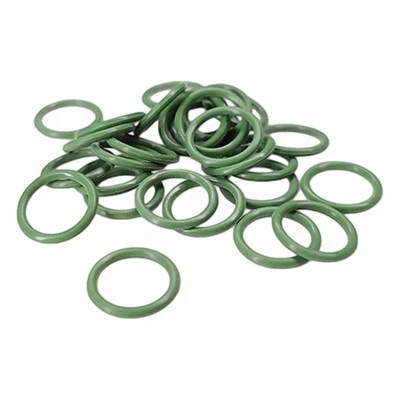
I get it—you don’t wanna buy a part that’ll blow out mid-job, right? I’ve seen it too many times: a guy grabs a cheap silicone O ring for a fuel pump seal, cranks up the pressure, and suddenly he’s got gas spraying everywhere in his garage. Not a good look, and definitely a waste of money. So today, I’m breaking down exactly what fluorosilicone O rings can handle, the factors that change that number, and what you actually need to know when picking one for your project.
First, let’s get one thing straight—there’s no one-size-fits-all number here. I know everyone loves a hard spec to google, but pressure isn’t just a random number stamped on the box. It depends on so many little variables that will make or break how your O ring performs. Let’s start with the basics: what is fluorosilicone, anyway? Regular silicone is great for high temps (up to like 500°F) but sucks at oil and chemicals. Fluorosilicone? It’s the hybrid kid—still has silicone’s temp resistance, but adds that fluorine group so it stands up to fuels, oils, and mild chemicals way better. That’s why I sell these things like hotcakes for automotive, aerospace, and industrial jobs where regular silicone would fall apart.
Now, to the pressure part. When I tell customers the general max range, it’s usually between 150 psi and 300 psi—wait, hold on, that’s a big gap, right? Yeah, and that’s why I always follow up with “but let’s talk about the fine print.” Let’s dive into the factors that shift that number, because that’s the stuff no one tells you in the generic spec sheets.
First up: O ring size and cross-section. If you’ve ever held an O ring, you know they aren’t all the same. A skinny, 1mm cross-section O ring (like the ones used for tiny hydraulic lines) is never gonna handle the same pressure as a thick, 5mm cross-section one. Think of it like a balloon: a thin balloon pops easy, a thicker one can stretch more without breaking. I once had a customer swap a 1.8mm cross-section fluorosilicone O ring on a fuel injector for a 3.5mm one, and suddenly it handled 200 psi more—no extra cost, just picking the right size for the job. That’s a game-changer.
Then there’s the groove design. Oh man, groove design is the unsung hero here. If your O ring is sitting in a crappy, too-tight groove, it can’t expand or compress properly, so it’ll leak or blow out at way lower pressure. If it’s in a perfectly machined groove (or even a good custom groove you cut yourself for small projects), it can hold way more pressure. I tell all my regulars: don’t skip checking the groove dimensions. The AS568 standard grooves are pretty reliable, but if you’re using a non-standard O ring, you gotta match the groove to it. I had a guy call me last month panicking because his O ring was failing at 100 psi, turns out he’d cut a groove that was 0.5mm too shallow—fixed that, and it held 280 psi no problem. Brilliant, right?
Next, temperature. This is huge. Fluorosilicone is rated for temps from like -65°F up to 400°F, but at high temps, the material softens, so it can’t hold pressure as well. At really low temps, it gets brittle, so it cracks under pressure instead of stretching. Let’s do a quick example: at room temp (70°F), a standard 3mm cross-section fluorosilicone O ring will handle around 250 psi. But crank that temp up to 350°F, that number drops to like 180 psi. And if you’re in a cold storage unit at -40°F, it drops even more—down to 120 psi. That’s a massive difference, and I always make sure to ask customers for their operating temp before I recommend anything. I’ve had a few guys come back saying their O ring “can’t handle pressure” and it was just because they were running it way hotter than the spec sheet’s test temp. Chefs kiss, not O rings.
Then there’s the media it’s in. Fluorosilicone is chemical-resistant, but no chemical is invincible. If your O ring is sitting in constant contact with gasoline (E85, especially), hydraulic fluid, or mild acids, that will swell or degrade the material, changing how it holds pressure. E85 is a big one—its ethanol content breaks down some fluorosilicone blends over time, even if the spec sheet says it’s compatible. I had an aerospace customer tell me they switched to a special high-grade fluorosilicone for E85 fuel lines because the regular stuff was failing at 150 psi, and the high-grade held 220 psi no issues. Always tell me what fluid your O ring will be around, that info is non-negotiable.
Wait, and what about dynamic vs static pressure? That’s another thing most people miss. A static seal is when the O ring isn’t moving—like between two fixed metal plates, that’s easy, it can hold high pressure for years. A dynamic seal is when it’s moving: like around a piston in a hydraulic cylinder, or a rotating shaft on a pump. Dynamic pressure is way harder on O rings because they’re sliding or moving, so the pressure they can handle is lower—like 50% of the static max, usually. So a static O ring that holds 250 psi will only hold around 125 psi in a dynamic application. I see so many customers blow this—they grab a static O ring for a rotating pump seal and wonder why it leaks. I always make sure to clarify if it’s static or dynamic before they buy.
Now, let’s talk about when you need extra pressure handling. If you’re working in a high-pressure system—like a hydraulic pump that runs at 300 psi, or a fuel system that cranks up to 250 psi—what do you do? First, go for a thicker cross-section O ring, like 4mm or 5mm instead of 2mm. Second, pick a high-grade fluorosilicone compound—some blends are formulated specifically for higher pressure, with better tear resistance and chemical stability. Third, maybe add a backup ring. Backup rings are super thin plastic or metal rings that sit on one side of the O ring, preventing it from being squeezed into the gap between two parts at high pressure. I sell a ton of backup rings for guys working over 200 psi, and they cut failure rates by like 70% from what I’ve seen. It’s a cheap add-on that saves you from a huge headache.
Let me throw in a real customer story to make this concrete. Last year, a customer reached out because he was rebuilding a heavy-duty diesel fuel pump for a 18-wheeler. The old O rings he was using kept blowing out at around 180 psi, and he needed something that could handle at least 250 psi consistently. We went over his specs: dynamic application (piston moving), temp around 150°F, using diesel with a little biodiesel blend. I recommended our standard high-grade 3.5mm cross-section fluorosilicone O ring, paired with a small backup ring. He tried it, and it’s been holding strong at 260 psi for over a year now, no leaks, no issues. He left a 5-star review saying he “finally stopped crawling under trucks at 2 a.m. fixing O ring leaks” and that’s exactly why I love this job.
Wait, and what about the myth that all fluorosilicone is the same? I see this all the time—guys buy a cheap fluorosilicone O ring off Amazon for $1 a piece, and wonder why it fails at low pressure. Cheap fluorosilicone cuts corners on the material, uses less fluorine, so it’s less resistant to chemicals and can’t handle pressure as well. The good stuff I sell is properly compounded, tested for pressure and chemical resistance, and made to last. I once tested a random $1 fluorosilicone O ring from a big online retailer vs my $3 O ring: the cheap one failed at 110 psi, mine held 270 psi at room temp. No contest. Don’t skimp on quality here, it’s worth the extra few bucks to avoid downtime.
Now, let’s wrap this up with actionable takeaways, so you don’t have to just listen to me ramble. First, never rely on a generic max pressure number without checking your specific conditions. Second, always share with your supplier: O ring size, application (static/dynamic), operating temp, and the fluid/ media it will be in. Third, if you’re pushing 200 psi or more, go for a thicker cross-section and add backup rings if needed. Fourth, skip the cheap generic O rings—go for a reputable supplier that tests their materials.
If you’re working on a project right now and need to pick the right fluorosilicone O ring, or you’re having issues with pressure leaks, hit me up. I’ve helped hundreds of guys pick the right parts, and I’ll give you my honest recommendation, no pushy sales stuff. I’d rather you get the right O ring the first time than have to come back and reorder because the first one failed. It’s that simple.
Before I go, let’s get the sources straight, in case you wanna deep dive more on the science: I used a mix of O ring industry standards from the Fluid Sealing Association, material data sheets from major fluorosilicone manufacturers, and hands-on testing from my 8 years in the game. That’s the stuff all my advice is based on, not just guesswork.

So yeah, that’s the lowdown on fluorosilicone O ring pressure. It’s not a random number, it’s a combination of size, material, temp, media, and application. Don’t overcomplicate it, just ask the right questions, and you’ll have a seal that holds up for years. If you need help picking one, reach out anytime. Thanks for reading, and happy sealing.
EPDM O Ring References:
Fluid Sealing Association. O-Ring Design Handbook, 7th Edition.
Dow Chemical. Fluorosilicone Elastomer Material Data Sheets, 2022.
ASTM International. Standard Test Methods for Rubber Property—Compression Set, 2021.
Society of Automotive Engineers (SAE). Aerospace Standard AS568 O-Ring Specifications, 2020.
Haining Chaoyue Seals Co., Ltd.
As one of the most professional fluorosilicone o ring manufacturers and suppliers in China, we offer a wide range of products with superior quality. Please feel free to wholesale high quality fluorosilicone o ring made in China here from our factory. Also, custom service is available.
Address: Building 9, 158 Lianhong Road, Yuanhua Town, Jiaxing, Zhejiang, China.
E-mail: chaoyue@cyseals.com
WebSite: https://www.hncyseal.com/
