Copper sulfate, a well – known chemical compound, has a wide array of applications in various industries. As a copper sulfate supplier, I’ve had the privilege of working closely with this fascinating substance, and I’m excited to share its physical properties with you. Copper Sulfate
Appearance
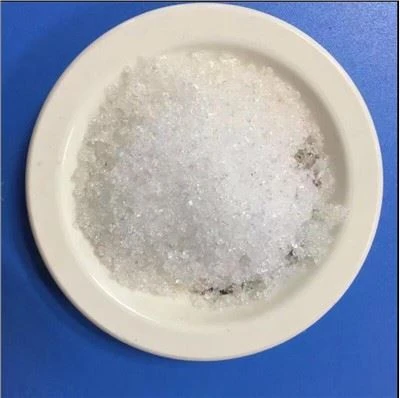
Copper sulfate commonly exists in two main forms: anhydrous and hydrated. Anhydrous copper sulfate ($CuSO_{4}$) is a white crystalline solid. Its structure consists of copper ions ($Cu^{2+}$) and sulfate ions ($SO_{4}^{2 – }$) held together by ionic bonds in a regular lattice arrangement. The white color is due to the absence of water molecules in its structure, which do not contribute to any specific absorption of visible light in a way that would give it a distinct color.
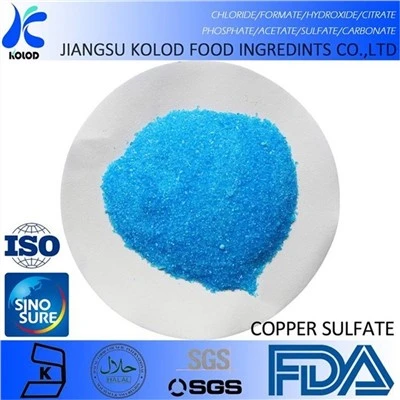
On the other hand, the hydrated form of copper sulfate, specifically copper(II) sulfate pentahydrate ($CuSO_{4}\cdot5H_{2}O$), is the most common and well – recognized. It appears as bright blue, large, triclinic crystals. The blue color is a result of the interaction between the copper ions and the water molecules in the crystal structure. The water molecules act as ligands, surrounding the copper ions and causing a splitting of the d – orbitals of the copper(II) ions. This splitting allows the copper ions to absorb light in the red part of the visible spectrum, and the complementary color, blue, is reflected, giving the compound its characteristic blue hue.
Solubility
One of the most important physical properties of copper sulfate is its solubility in water. Copper(II) sulfate pentahydrate is highly soluble in water. When added to water, the polar water molecules interact with the ions in the copper sulfate crystal. The positive ends of the water molecules (hydrogen atoms) are attracted to the negatively charged sulfate ions ($SO_{4}^{2 – }$), while the negative ends (oxygen atoms) are attracted to the positively charged copper ions ($Cu^{2+}$).
As the water molecules surround the ions, they overcome the ionic bonds holding the crystal together, and the copper sulfate dissolves to form a blue aqueous solution. The solubility of copper(II) sulfate pentahydrate increases with temperature. At room temperature (around 20°C), approximately 32 grams of copper(II) sulfate pentahydrate can dissolve in 100 milliliters of water. As the temperature rises to 100°C, the solubility increases to about 203 grams per 100 milliliters of water.
In addition to water, copper sulfate is also slightly soluble in methanol and glycerol. However, it is insoluble in ethanol and most non – polar organic solvents. This difference in solubility is due to the nature of the solvent molecules. Polar solvents like water, methanol, and glycerol can interact with the ionic copper sulfate through dipole – ion interactions, while non – polar solvents lack the necessary polarity to break the ionic bonds in the copper sulfate crystal.
Density
The density of copper sulfate varies depending on its form. Anhydrous copper sulfate has a density of about 3.6 grams per cubic centimeter. The higher density of the anhydrous form is due to the more compact arrangement of the copper and sulfate ions in the crystal lattice without the presence of water molecules.
Copper(II) sulfate pentahydrate has a lower density, approximately 2.286 grams per cubic centimeter. The water molecules in the pentahydrate form occupy space within the crystal structure, increasing the volume without a proportionate increase in mass compared to the anhydrous form. This results in a lower overall density.
Melting and Boiling Points
Anhydrous copper sulfate has a relatively high melting point of about 650°C. At this temperature, the strong ionic bonds between the copper and sulfate ions are broken, and the solid changes into a liquid state. When heated further, anhydrous copper sulfate decomposes at around 1100°C, releasing sulfur trioxide gas ($SO_{3}$) and leaving behind copper(II) oxide ($CuO$).
Copper(II) sulfate pentahydrate undergoes a different thermal behavior. When heated gently, it loses its water of crystallization in a step – wise manner. At around 100 – 110°C, the pentahydrate starts to lose four of its five water molecules, forming a monohydrate ($CuSO_{4}\cdot H_{2}O$), which is a pale blue solid. As the temperature is increased to about 250°C, the remaining water molecule is lost, and anhydrous copper sulfate is formed. The loss of water is accompanied by a color change from the bright blue of the pentahydrate to the white of the anhydrous form.
Hygroscopicity
Anhydrous copper sulfate is hygroscopic, which means it has the ability to absorb water from the surrounding environment. When exposed to air, anhydrous copper sulfate quickly absorbs water vapor and gradually turns blue as it forms the hydrated pentahydrate. This property makes it useful as a desiccant in some applications, where it can be used to remove moisture from a system.
On the other hand, copper(II) sulfate pentahydrate is stable under normal atmospheric conditions and does not readily lose or gain water. However, if the relative humidity is very low or if it is heated, it can lose its water of crystallization as described above.
Crystalline Structure
The crystal structure of copper(II) sulfate pentahydrate is unique. In the pentahydrate, four of the water molecules are coordinated to the copper(II) ion in a square – planar geometry. The fifth water molecule is hydrogen – bonded to the sulfate ion and to other water molecules in the crystal lattice. This complex structure gives the pentahydrate its characteristic blue color and its large, well – formed crystals.
The arrangement of the ions and water molecules in the crystal lattice also affects the physical properties of the compound, such as its solubility and density, as discussed earlier. The strong hydrogen – bonding and coordination interactions within the crystal lattice contribute to the stability of the pentahydrate form under normal conditions.
Applications Based on Physical Properties
The physical properties of copper sulfate make it suitable for a wide range of applications. Its solubility in water makes it easy to use in agricultural applications as a fungicide and algaecide. When dissolved in water, it can be sprayed on crops or introduced into water bodies to control fungal diseases and algae growth.
The blue color of copper(II) sulfate pentahydrate makes it a popular choice in educational settings for demonstrating chemical reactions and crystal formation. It is also used in the electroplating industry, where its solubility and the ability of copper ions to be reduced at the cathode are utilized to deposit a layer of copper on various objects.
In the mining industry, the density and solubility properties of copper sulfate are important for the extraction and purification of copper. It can be used in the flotation process, where the physical properties of copper sulfate – containing solutions are adjusted to separate copper minerals from other impurities.
Contact Us for Your Copper Sulfate Needs
As a reliable copper sulfate supplier, we understand the importance of these physical properties in different applications. Whether you are in the agricultural, chemical, educational, or any other industry that requires copper sulfate, we can provide you with high – quality products that meet your specific requirements.
Zinc Sulfate If you are interested in purchasing copper sulfate, we invite you to contact us for a detailed discussion. We offer a range of copper sulfate products, including both anhydrous and hydrated forms, and can provide information on pricing, packaging, and delivery options. Our team of experts is always ready to assist you in making the right choice for your business. Let’s start a conversation about how we can meet your copper sulfate needs and help you achieve your goals.
References
- Housecroft, C. E., & Sharpe, A. G. (2012). Inorganic Chemistry. Pearson Education.
- CRC Handbook of Chemistry and Physics. (2019). CRC Press.
- Lide, D. R. (Ed.). (2018). Lange’s Handbook of Chemistry. McGraw – Hill Education.
Jiangsu Kolod Food Ingredients Co., Ltd.
As one of the most professional copper sulfate manufacturers and suppliers in China, we’re featured by quality products and good price. Please rest assured to wholesale bulk copper sulfate made in China here and get free sample from our factory. Customized orders are welcome.
Address: South Side of Weier Road, Guanyun Development Zone, Lianyungang City, Jiangsu Province, China
E-mail: sales1399@jskolod.com
WebSite: https://www.kolod-group.com/
